The Wildlife of Peninsula Papagayo: What You'll See and Where
The howler monkeys will wake you before your alarm does. Here is what lives on Peninsula Papagayo, from capuchins at the villa edge to the endangered scarlet macaw, and how to see more of it than most visitors do.
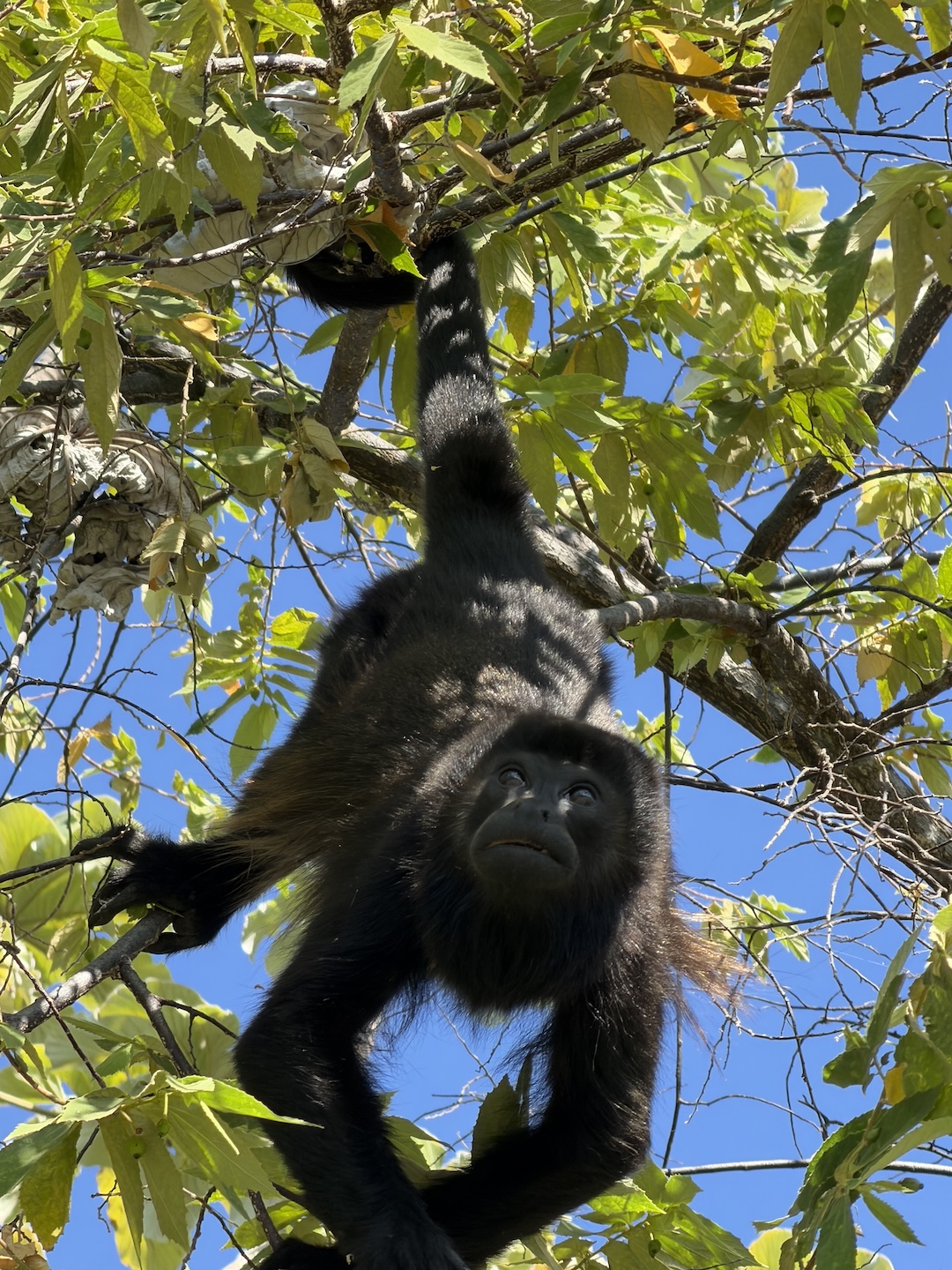
The howler monkeys will wake you before your alarm does. This is the first thing to understand about Peninsula Papagayo. It is a luxury destination built inside a working ecosystem, and the ecosystem does not observe check-in times.
Most guests arrive expecting to see a monkey or two. What surprises them is how little effort it takes, and how much is going on once they start paying attention. You do not hike for hours here to find wildlife. It comes to the balcony, crosses the fairway, suns itself on the villa wall. Roughly seventy percent of the peninsula's 1,400 acres is protected, and the animals treat the rest as theirs too.
Here is what lives here, where to look, and how to see more of it than the average visitor does.
The Monkeys
Three things you will hear about, and two you will actually meet.
Howler monkeys are the alarm clock. Their call carries for miles and sounds far larger than the animal producing it, a low roar that rolls across the forest at dawn and dusk. The first morning it can be startling. By the third it is the sound of the trip, the thing you will miss when you get home.
White-faced capuchins are the ones you will watch for real. Quick, curious, and social, they move through the trees at the edges of the villas and along the golf course in troops. They are clever enough to be a genuine nuisance around food, so enjoy them and do not feed them, which is both bad for the animal and against the rules for good reason.
Between the two, the peninsula gives you Costa Rica's most iconic wildlife encounter without a guide, a gate, or a drive. It is simply part of being here.
The Birds
Costa Rica is home to more than 850 species of birds, and the peninsula sits inside one of the more productive corners of that map. Toucans are the headline, and they do turn up. But the story worth knowing is the scarlet macaw.
The scarlet macaw was devastated across this region by the illegal pet trade and is now endangered on the Nicoya Peninsula. Working with Costa Rican government agencies, Peninsula Papagayo runs a dedicated program to protect and reintroduce the species, through habitat management, breeding, monitoring, and education. When one crosses the sky here, red and blue against the green, you are watching a conservation effort in progress, not just a beautiful bird. That is a rarer thing to witness than most guests realize.
Beyond the macaws, the forest carries yellow-naped parrots, trogons, and a long list of others. The peninsula is a Certified Audubon Cooperative Sanctuary, which means the birding is genuinely good, not incidental.
The Everyday Cast
The animals you will stop noticing by day three, because they are everywhere.
Iguanas on the walls and streets, motionless in the sun. Coatis, the long-nosed relatives of the raccoon, moving in loose groups with their tails up. Agoutis darting through the underbrush. Butterflies in numbers that photographs never quite capture. None of these require any effort at all. They are simply the texture of the place.
The Dry Forest, Which Is the Real Story
Here is the thing almost no one tells you before they arrive: the tropical dry forest is rarer than rainforest, and the peninsula holds one of the last significant stretches of it on the planet.
It behaves unlike the Costa Rica most people picture. Through the green season, from May into November, it is dense and lush, an opaque wall of green. Then the dry months arrive and it transforms completely, dropping its leaves and turning honey and gold, the canopy opening up so that ocean views appear between bare branches that were solid green weeks before.
This matters for wildlife in a specific, useful way. In the dry season the animals concentrate around the remaining water, and the bare canopy makes them far easier to spot. If seeing wildlife is a priority for your trip, the golden months from roughly December through April are when the forest gives the most away, even though it looks less like a jungle.
The peninsula neighbors the Área de Conservación Guanacaste, a UNESCO-recognized expanse of some 400,000 protected acres holding four distinct tropical ecosystems and more than 900 vertebrate species. You are not near this wilderness. You are inside its corridor.
The Palmares Preserve
At the heart of the peninsula sits The Outpost at Palmares Preserve, 250 acres of protected wilderness with an estuary, mangroves, and dry forest folded into one valley. It is a seasonal sanctuary for birds, butterflies, reptiles, and mammals, and it is the gateway to the larger conservation area beyond.
The peninsula's naturalist program, the Papagayo Explorers, runs guided outings from here: wildlife hikes, canopy ziplines across the treetops, and made-to-order expeditions that go deeper into Costa Rica with expert guides who can tell you what you are looking at and why it matters. This is the difference between seeing a monkey and understanding the forest it lives in, and for a lot of guests it becomes the most memorable day of the trip.
How to See More of It
A few things we tell our guests.
Early and late are everything. Wildlife is most active in the first hours after dawn and the last before dusk. Coffee on the terrace at sunrise will show you more than a midday walk ever will.
Stay still and stay quiet. The forest reveals itself to people who slow down. The guests who see the most are usually the ones doing the least.
Do not feed anything. The capuchins in particular will make it tempting. Feeding them harms the animals, changes their behavior, and is against the rules across the peninsula.
Bring or borrow binoculars. The macaws and trogons are often high in the canopy, and the difference between a distant shape and a genuine sighting is a decent pair of lenses.
Go with a naturalist at least once. Even a single guided outing rewires how you see the rest of the week. You start noticing what you walked past on day one.
Staying Inside the Forest, Not Beside It
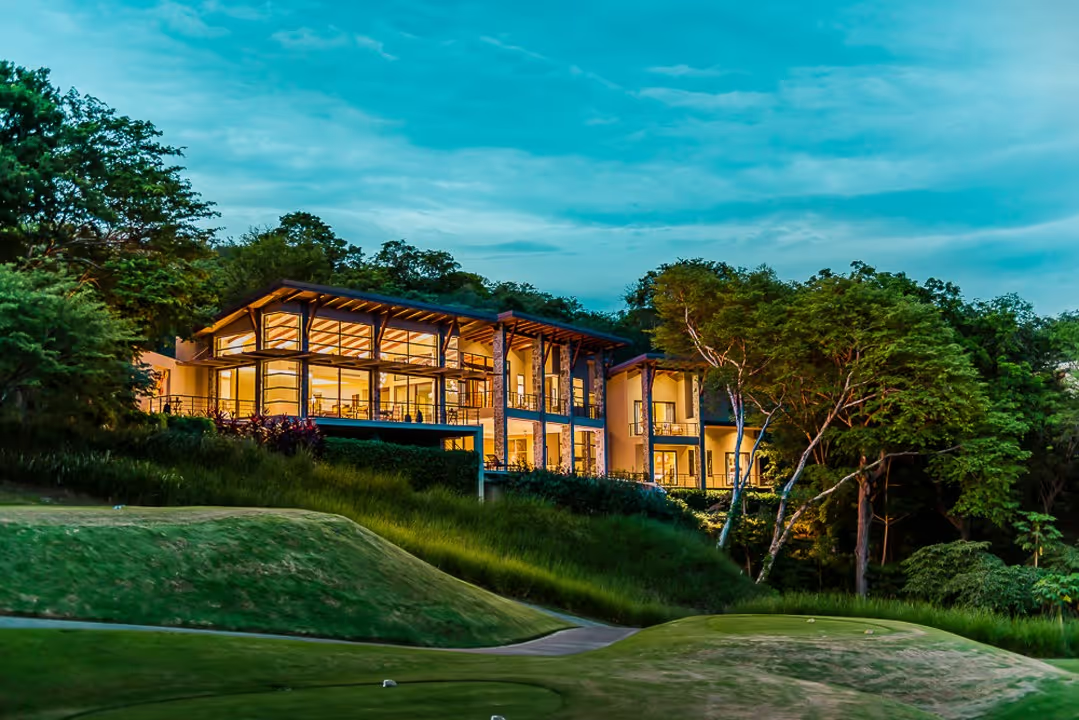
Part of what makes a villa the right way to experience this is where the houses sit. Ours are set into the same forest the wildlife moves through, which means the balcony at dawn is its own wildlife hide. The howlers, the capuchins at the tree line, the iguana that adopts your wall for the week, all of it happens from where you are already standing, coffee in hand.
Our concierge coordinates the guided side of it too. Most of the excursions run through the peninsula's Explorers program, the naturalist-led hikes and the Palmares outings, and we handle the booking and timing so the structured adventures and the quiet mornings both get their due. It is a rare combination, genuine wilderness and a comfortable place to watch it from.
Some places deserve more than a hotel. If a trip built around Costa Rica's wild side is what you are after, reach out through thesmartvillas.com and we will help you plan it, dawn chorus included.
Let us craft something extraordinary.
Arrange a consultation with our team. We'll understand what you need, then tailor a residence and itinerary to fit — usually within a few hours.
Frequently asked questions.
Everything you need for a seamless stay
The Smart Villas is a curated collection of luxury villas, not a marketplace. That means no platform fees, no service charges, and no algorithm deciding what you see. Booking directly with us typically saves guests 12–15% compared to the same property listed on Airbnb or VRBO.
Every home is individually selected, and every stay is concierged by our team from arrival to departure. Guests don't deal with an app or a call center. They deal with people who know these homes personally and handle every detail — transfers, restaurant reservations, local experiences — as a baseline, not an add-on.
Staying in a Smart Villa means you get the full Papagayo resort experience without being confined to one property.
Golf cart to the Four Seasons for dinner. Walk to the Ritz-Carlton Reserve for a spa treatment. Hit the Arnold Palmer Golf Course in the morning, come home to your private pool in the afternoon. The beach clubs, the restaurants, the activities, all of it is accessible.
You're just not paying resort prices to sleep in a hotel room when you could have an entire home. The guests who choose a villa aren't skipping the resort experience. They're adding to it.
We usually answer in a matter of minutes to all new messages.
We're happy to assist you with any questions regarding your stay, destination, or tailored travel experience.
Contact us